









Beyer Dial 3940J Patek Philippe Perpetual Calendar
When the 3940 began, it started at the top. Beyer, the world’s oldest independent retailer in business for 266 years, got the first 25 examples. They even got their name on the dial, over doré, individually numbered. Numbers 1 to 15 have a German dial, while 16 to 25 are in English. All were delivered in 1985 at the start of production with what we now call First Series dials (Stern, not Singers). These initial 25 examples are easily the most desired 3940s made. Mr Philippe Stern famously wore one such example daily, and he knew a thing or two about austere beauty. And one such example is now heading to auction.
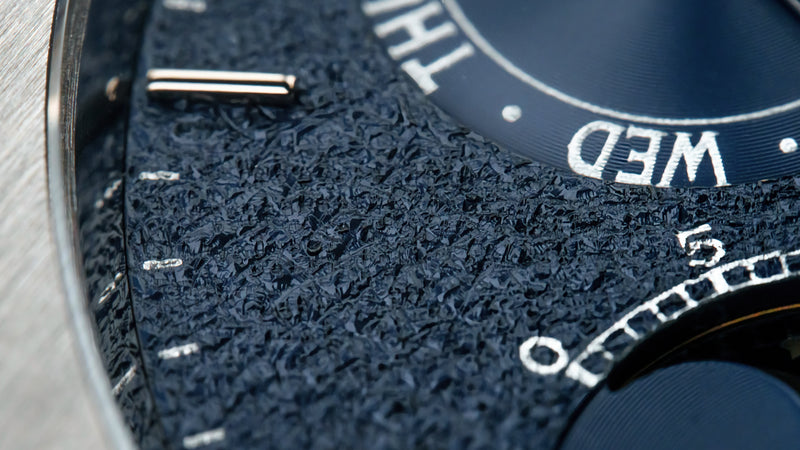
The subdial apertures with their dramatic step were hand-finished, indices hand-applied. First Series production lasted only the initial two years, until 1987. Other identifying traits are the surviving grave accent over the second ‘E’ of Genève. Subdial fonts also include serifs. Here, hallmarks flank the correcting pusher at 9 instead of lug backs. While they’re lost totally with the lightest polish, this example retains them in full relief. First Series mark the handoff from manual production techniques to the later series’ scaled contemporary techniques.

Recent years have seen the Philippe Stern era of Patek Philippe and its associated austere designs as some of the manufacture’s very best work. On the verge of being considered vintage, these references offer the reliability of modern watchmaking with the tighter proportions and restrained design of vintage production. In early series, these encompass some manual technique as well. While there are many Perpetual Calendars, the 3940 is one which helped the complication rise to fame and desirability. Its role in creating desire for complication cannot be overstated. This is obviously a shared opinion, as recent results for Beyer 3940 have for the first time in history eclipsed 1M USD. These are now being collected amongst the very greatest productions from Patek Philippe, and deserve to be. These were the very step from manual technique to serial production, the old shaking hands with the new.
This example has the full works and whilst the hallmarks aren't clearly visible, it look pretty great overall.


0 comments
Write a Comment