







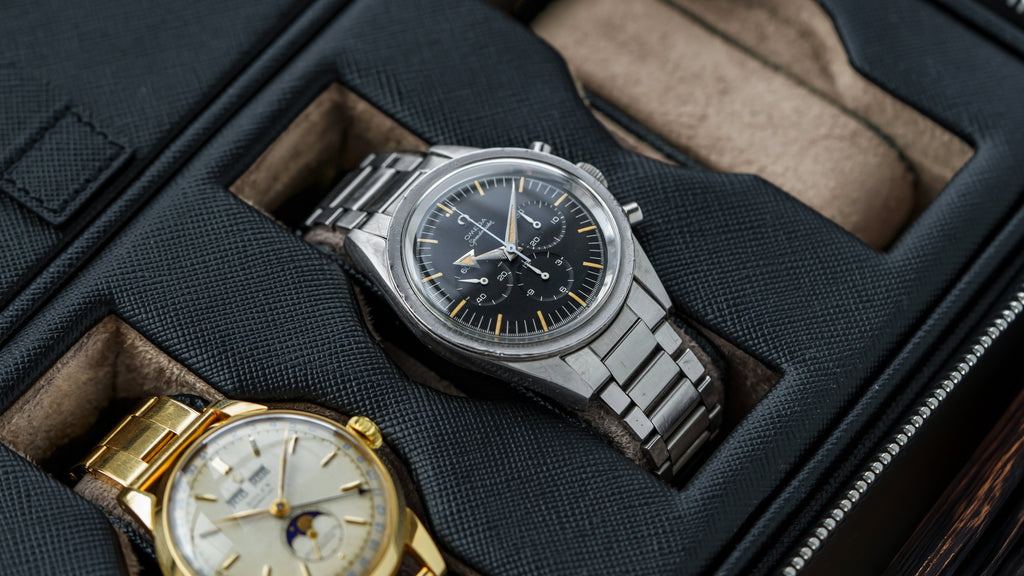


3450J Patek Philippe Perpetual Calendar
If one were to discuss greatly overlooked complicated Patek Philippe, the 3450 is definitely in that category. The 3450 could be described as transitional, launched in 1981 and taking over from the first self-winding QP ref. 3448, it was quickly succeeded by Philippe Stern’s inimitable 3940 in 1985. Effectively, it was a 3448 with leap indication. Around 244 examples were made, with roughly 200-220 J/yellow gold, 10-15 G/white gold, and a mythical 2 in P/platinum. That is far tinier than the 3448’s 586 examples or estimated 7,000 example 3940 production. Regardless of metal or numbers, it was the very first QP from Patek that you could reliably and easily set yourself.
 First two images here including headline are prior listings, lifestyle images courtesy of Phillips.
Made for just 4 years, examples are few and far between. The 3450 is largely divided into two series based on the style of leap indication. The earlier series used a red disc for the leap year with Arabic numerals elsewhere. The later series use Roman numerals for all 4. In terms of condition, seeing the unusual vertical brushing on the lug outer might seem odd, but that’s right where it should be. Now, by the time we get to 3450 dials have moved from engraved enamel to pad printing, that change happened within the production of 3448. All the other condition cues still apply. The 3450 is the height of 70s-meets-80s design cues at Patek Philippe. It was also the last full-rotor QP.
 The actual example in question, with Keystone
The 3448 had been in production for 20 years, the successor was never going to be easy. Fun fact: even though I just said this and am contradicting already, the true first Patek QP with leap indication was a piece unique 3448 made for Alan Banbery with leap indication in place of a moonphase at 6. But this was the first time it was serialized. While the thinnest of a 3940 and the charm of a 1526 often pull collectors in a barbell shape away from the 3450, they are resplendent. Particularly when, as is the case here, its owner special ordered a sapphire caseback, which you almost never saw.
 Sapphire caseback, who knew? Won't see that again soon.
This example comes to market from a prior auction, still in great shape. It should be noted that the 750 hallmarks on these were never pressed in super deep as you might be used to on lug backs, they were always pretty shallow. That said, this case is strong but not quite perfect. It comes from a well-regarded California retailer.



0 comments
Write a Comment