








Hazemann & Monnin: An Interview on the Formative Years Leading to the Brand
Many independent watchmakers spend years at a larger house before starting their own manufacture. Alexandre Hazemann and Victor Monnin went straight from school to a workshop of their own.
Hazemann & Monnin met their first year at Lycée Edgar Faure in Morteau, the iconic watchmaking institution on the French side of the Swiss border. In their final year, they decided to build their school watches together, which no two students at the institution had done in around two decades. Their watches paired an instantaneous jumping hour with a sonnerie au passage, a strike on a gong at the top of every hour, to which Hazemann’s version went on to win the 2023 F.P. Journe Young Talent Competition.
Their academic partnership & friendship led to establishing their very own workshop in 2024 located in Saint-Aubin-Sauges, Switzerland. As a brand, their first watch reworked their former school project around a calibre designed,manufactured, and decorated in-house: the HM01. In March 2026, that watch was awarded the first-place prize in the second edition of the Louis Vuitton Watch Prize for Independent Creatives.
Throughout this interview, we explore the formative years leading to the Hazemann & Monnin brand, tracing how an unconventional path brought immediate success to their independent workshop. Thank you to Alexandre Hazemann and Victor Monnin for taking the time to answer our questions in such detail, and for letting us share their story with our readers.
Responses were provided in writing by Victor Monnin on behalf of both watchmakers.

All Photos used in this article are courtesy of Hazemann & Monnin.
01 / THE MEETING
When you first met at the Lycée Edgar Faure in Morteau, what brought you together and led to such a close friendship, and eventually to your professional partnership?
What brought us together, even before our friendship and partnership, was above all a shared approach to work. We often think back to our early years at school, when we were regularly assessed in the workshop, in movement construction or in design. There were around thirty students, divided into two groups of fifteen. Alexandre and I were not even in the same group, yet we were consistently the last two to leave the workshop.
We shared the same determination to make the most of every minute we were given, to fulfill our potential and to see things through. That desire to give everything we had naturally brought us closer. It was also what prompted us to work together on our school watch project in our seventh and final year of study.
02 / CHOOSING THE COMPLICATION
For your final-year project, you developed a passing strike combined with a jumping hour. How was that decision made? Did anyone advise you against taking on the project?
In fact, we did not choose the specifications ourselves. They were set by the teaching staff as part of a project supported by Arnold & Son and its technical department. Everyone in our year worked within the same technical constraints, but each student was free to interpret them, both mechanically and aesthetically. Alexandre and I were the only ones who decided to join forces to tackle the challenge. And that was precisely the decision we were advised against. Collaborative projects had often failed in the past, particularly because of differences in ego, taste or working methods. We decided to give it a try nonetheless. I am convinced that the project's success came from what we had in common: our approach to work, our love of watchmaking and our determination to create something that would not simply look like a school exercise, but a genuinely finished, wearable and collectible watch.

03 / TIME CONSTRAINTS
You had just nine months. Were there mechanisms or ideas you would have liked to explore if time had not been such a significant constraint?
Nine months is an extremely short time to go from a philosophical and artistic concept to a functioning watch. You inevitably have to make choices. With more time, we would certainly have liked to develop our own base movement.
For our school watches, we used an existing automatic movement, which served its purpose perfectly. But designing your own calibre is a dream shared by many watchmakers. It is exactly what we set out to do when we established our workshop, developing our own movement. In doing so, we were able to realize an ambition that the constraints of our school project had not yet allowed us to pursue.
04 / THE ART OF THE STRIKE
How fine is the line between a perfectly made gong and one that breaks? And when listening to a striking watch, what defines good sound quality?
The difference between a perfectly made gong and one that breaks lies mainly in its hardness, and therefore in how well its heat treatment is controlled. Hardening must be carried out under extremely precise conditions, with carefully controlled temperatures, as must the tempering process that follows.
In terms of sound quality, we aim above all for a note close to 440 Hz, which is particularly pleasing to the ear. The sound should be pure, almost crystalline, while retaining a beautiful resonance, ideally lasting two to three seconds. A strike that is too short makes the watch seem to lack resonance. Conversely, a sound that lacks clarity can reveal unwanted vibrations, as though the gong were bouncing and the note gradually deteriorating. What we seek is that balance between purity, clarity and the length of the resonance.

05 / CREATING THE HM01 CALIBRE
While your school watches were based on the LJP 6900 calibre, the HM01 was developed entirely in-house. What did creating your own movement allow you to achieve?
Developing a movement from scratch gives you tremendous freedom. With our school watch, certain constraints were dictated by the architecture of the existing movement, particularly the position of the seconds wheel at nine o'clock.
With our own calibre, we were able to rethink the entire architecture, freely design the shape of the bridges and choose the characteristics of the balance wheel. In particular, we opted for a frequency of 2.5 Hz, or 18,000 vibrations per hour, allowing us to use a large balance wheel. This is something we are especially attached to, as it recalls the charm of early twentieth-century school watches, in both Switzerland and France. We were also able to develop our own barrel, taking into account the significant energy demands of our complication. Timekeeping performance and power reserve still have to meet our standards. Designing our movement from the ground up allowed us to strike that balance between aesthetic freedom, mechanical architecture and technical performance.
06 / MANAGING ENERGY
As the snail cam controls both the hour jump and the release of the hammer, what changes did you have to make to the movement? How did you prevent this from affecting its accuracy?
The snail cam, together with the main lever, is involved in three essential functions: reading the information from the cam, the instantaneous hour jump, and the cocking and subsequent release of the hammer. To make all three actions work, we had to undertake extensive mechanical optimisation. We focused particularly on friction and contact surfaces, polishing them to an exceptional degree to minimise energy loss. We also devoted a great deal of attention to oils and lubrication. Because the complication draws its energy from the same barrel as the movement, its operation inevitably affects the power reserve.
We set ourselves a particularly ambitious target: to limit the additional energy consumption to around 10%. Today, our movement has a power reserve of approximately 55 hours without the complication operating, compared with 50 hours with it. We have therefore achieved a result very close to our original target.

07 / THE INSTANTANEOUS JUMP AND STRIKE
How does the instantaneous jump work mechanically, what difficulties did you encounter, and how did you resolve them?
The operation of the instantaneous jump and striking mechanism depends, in particular, on very precise control of the main lever's inertia. The aim was to achieve a perfectly clean jump, without a double jump or insufficient energy when the main lever drops back onto the cam. We spent an enormous amount of time making this mechanism reliable during our studies.
By the end of the nine-month development period, the complication in our school watches was already highly reliable. When we developed the subscription watches in 2024, we mainly reworked the movement and the case dimensions. As for the complication, our improvements focused chiefly on the gong, particularly its shape, hardness and length, to improve the quality of the strike. The instantaneous-jump mechanism itself was already working very well, so we did not need to fundamentally redesign it.
08 / AESTHETIC CHOICES
Victor, what led you to choose stone for the sundials? Alexandre, what inspired the skeletonization?
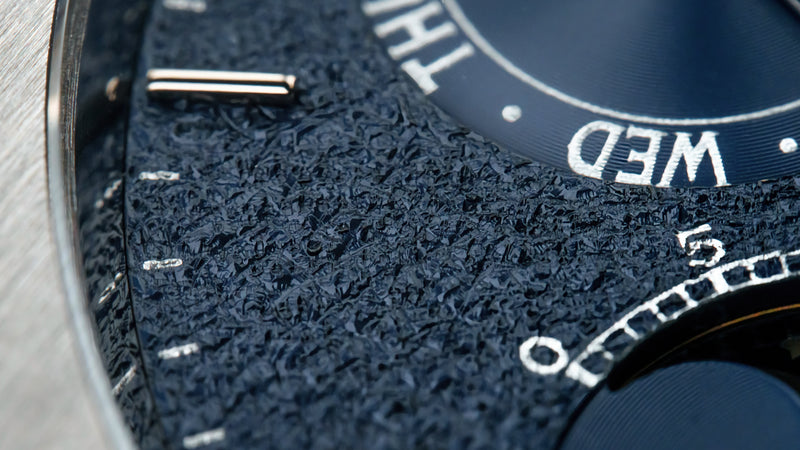
For the stones, above all we wanted to work with materials that have real character. Green and white are two colours that work particularly well together. Malachite offers a multitude of shades, from forest green to much lighter tones, with very organic patterns, almost as though drawn by nature. Opal, meanwhile, has an almost pearlescent shimmer that gives the subdials a very distinctive character. We did not want stones that felt bland. The idea was truly to give the watch a soul, to bring it to life once the dial was fitted.
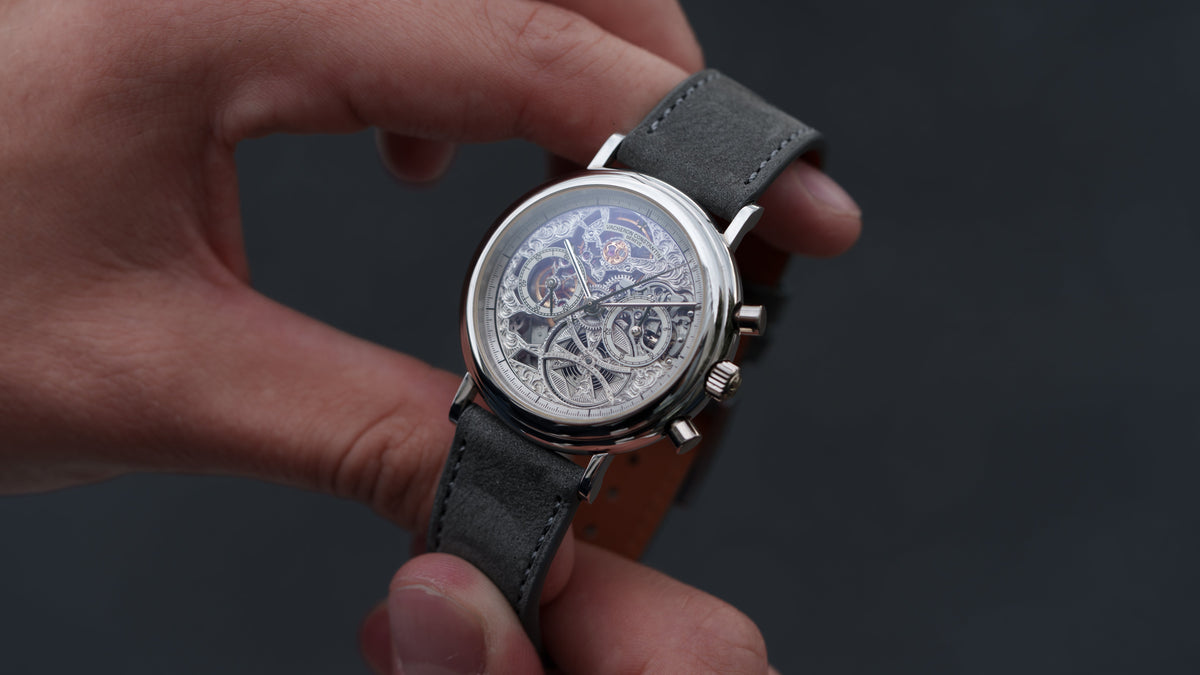
As for the skeletonisation, Alexandre's intention was above all to make the mechanical work visible. Making something look simple is always more difficult. When you reveal a complication on the dial side, it is very easy to end up with an extremely complex, almost illegible architecture. Our thinking was informed in particular by the work of Abraham-Louis Breguet, Ferdinand Berthoud, George Daniels and François-Paul Journe. The idea is to reveal the beauty of watchmaking mechanics and share it with the person wearing the watch, rather than systematically hiding it beneath a dial.
09 / FROM SCHOOL TO WORKSHOP
What are the most significant differences between making your school watch and producing watches as a business?
The biggest difference is the resources we have at our disposal today. In our workshop, we have access to more equipment, fixtures developed specifically for our needs and high-quality tools that allow us to work under better conditions. We can also draw on external partners, whose support and experience provide a valuable source of information and knowledge. But perhaps the most important difference is the time we can devote to our watches. During our studies, we had to work on the project alongside all our other subjects: mathematics, movement construction, finance and design, among others. In practice, we had only two days a week to work directly on our watches. Today, we can dedicate six, sometimes seven, days a week to development.

10 / THE LOUIS VUITTON MENTORSHIP
Since winning the Louis Vuitton Watch Prize for Independent Creatives in March 2026, what do you hope to gain from the mentorship of Michel Navas and Enrico Barbasini’s team?
The Louis Vuitton Watch Prize provides support in many areas, far beyond the purely technical aspects. We also receive guidance on communication, business management, project management and, more broadly, everything involved in organizing and developing a watchmaking house.
The aim is to structure our business so that we can devote as much time as possible to what truly drives us: mechanical development, design and creation. All the administrative and organisational work is essential to running the workshop, but it takes an enormous amount of energy. Being able to benefit from the experience and advice of professionals in these fields is therefore a real opportunity for us.

11 / THE ENTREPRENEURIAL CHALLENGE
What has been the most difficult challenge in establishing your own brand?
Whenever we undertake something, we always want to do it properly, see it through and get every detail right. Perhaps the hardest thing at the beginning was having to wear so many hats that were not naturally ours. I studied watchmaking and movement construction for seven years, and Alexandre for eight. But we had not been trained to negotiate with suppliers, work with accountants, banks or insurers, or structure a business. We therefore had to learn an enormous amount alongside our actual craft. Ultimately, the real challenge was not simply to create watches, but to build a business capable of operating seriously and professionally while remaining true to our standards.
12 / COLLECTORS AND DEMAND
What does a fair allocation of watches to collectors look like to you? And how have you managed such strong demand?
We are not necessarily trying to establish some form of absolute fairness in the allocation of our watches. What matters most to us is working with collectors who share our passion: thoughtful, receptive and interesting people who take a genuine interest in our work.
Faced with the level of demand, we devoted an enormous amount of time to speaking with the people who contacted us. Sometimes that meant entire evenings, even nights, trying to respond to everyone and leave no one overlooked. It is a considerable investment, both in time and personal energy. Having conversations with enthusiasts from all over the world is a privilege, but it also requires a great deal of availability.
13 / WATCHMAKING INSPIRATIONS
Which contemporary and vintage watches would you like to collect in the future? Which watches have inspired you both?
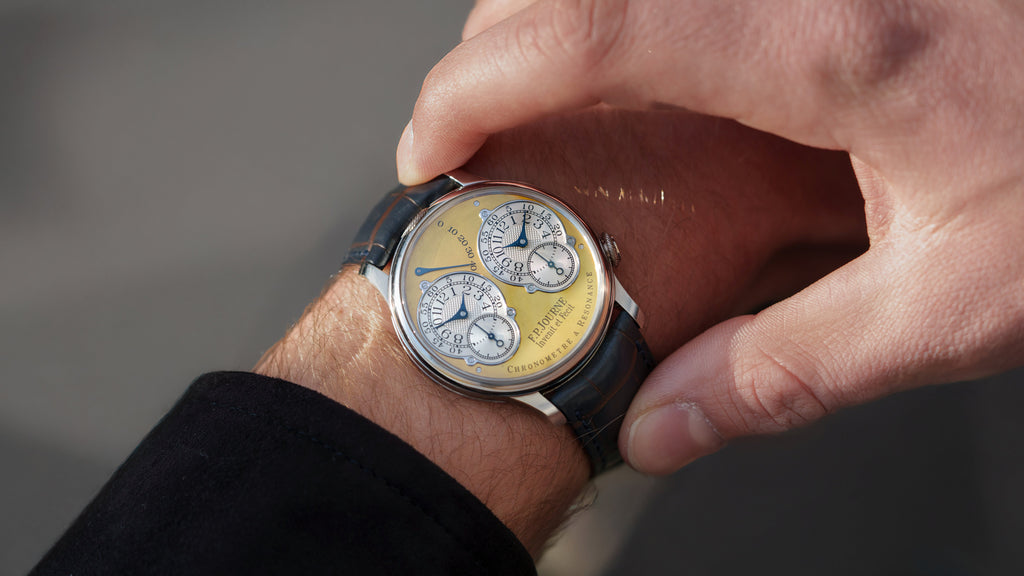
There are countless watches we would love to collect, both historical and contemporary pieces. We are particularly drawn to pocket watches by Patek Philippe and George Daniels, as well as the work of watchmakers such as Kari Voutilainen, Philippe Dufour, François-Paul Journe and Rexhep Rexhepi.
These are people and approaches to watchmaking that inspire us enormously. We have also started collecting nineteenth-century clocks and would like to continue in that direction. They are objects we enjoy displaying in our workshop. They bear witness to an era when watchmaking held a particularly important place and craftspeople sought, above all, to prioritize quality over quantity.
14 / MUSIC IN THE WORKSHOP
Many watchmakers listen to music or podcasts while they work. If I quietly removed one of your earbuds on a Thursday afternoon, what would each of you be listening to?
At the bench, we hardly listen to music anymore. It is a habit we gradually moved away from so that we could stay fully present and focused on the work of our hands. So we do not really have a particular track for assembly or finishing. But if we were to give those moments a soundtrack, a few associations come naturally. To immerse ourselves completely in our work, it would be “N Side” by Steve Lacy. When we are racing against a deadline, “luther” by Kendrick Lamar: something that keeps moving without slowing down.
When a watch is finally finished, we would imagine the Bee Gees or Silver Convention, a touch of the 1970s to celebrate the moment. And when something is not working, Marvin Gaye's “Inner City Blues” captures that moment of regrouping before starting again.
On Sundays, when the workshop becomes quiet again, Kanye West's “Closed on Sunday” would almost be too obvious, but rather fitting. There are also songs we have kept coming back to over the years, such as “Sweet Vibrations” and “Let Me Go” by Latimore, which create an atmosphere without ever taking over. Finally, for decoration and the finest details, we are particularly attached to the last verse of Bettye Swann's “Little Things Mean a Lot”. The title alone says a great deal about the way we work.
15 / THE FUTURE OF HAZEMANN & MONNIN
What does the future hold for Hazemann & Monnin? Are you working on any exciting projects you can tell us about?
Our future projects remain confidential for now. After the school watch, our greatest challenge is to create something new that is just as meaningful and fully expresses our own vision of watchmaking and mechanics. We want to continue developing complicated watches, always seeking that balance between design and engineering. That is very much the direction in which we want to take Hazemann & Monnin. We will reveal more in March 2027, but unfortunately we cannot say anything further at this stage.
16 / AN UNCONVENTIONAL PATH
Your success while still at school led you to establish your own company directly, rather than spending several years at a major watchmaking house. Did you encounter any resistance? What advice would you give young watchmakers hoping to follow a similar path?
There were probably criticisms, reservations or preconceived ideas about our decision, but we never sought to engage in those discussions. We prefer to focus on our vision and on what we want to achieve in watchmaking. There will always be people who are envious or jealous. But what really matters is building a project around a strong vision, firm convictions and, above all, a desire to do things well.
When we speak with young watchmakers, particularly those we welcome as interns to pass on our knowledge, we encourage them first and foremost to take time to think. These are not easy decisions. You need to surround yourself with the right people and understand that making a watch is not enough to build a watchmaking house. Designing a watch is already an immense challenge, but making ten, twenty or fifty is an entirely different matter.
I also believe it is essential for a young watchmaker to gain hands-on experience and develop genuine versatility. Movement designer, watchmaker, micromechanic and mechanic are all different professions, each requiring specific skills. You need to appreciate that diversity and try to understand as much as possible. Then, at some point, you simply have to take the leap, accept that you will make mistakes and learn from them.



0 comments
Write a Comment